Human-State Aware Human-Robot Collaborative Disassembly

Developing a human-centric HRC framework for high-value end-of-life (EoL) disassembly that adapts task allocation and robot behaviour to real-time operator state, combining cognitive and physiological modelling, negotiation-based collaboration, and a predictive digital twin to improve safety, ergonomics, and execution reliability.
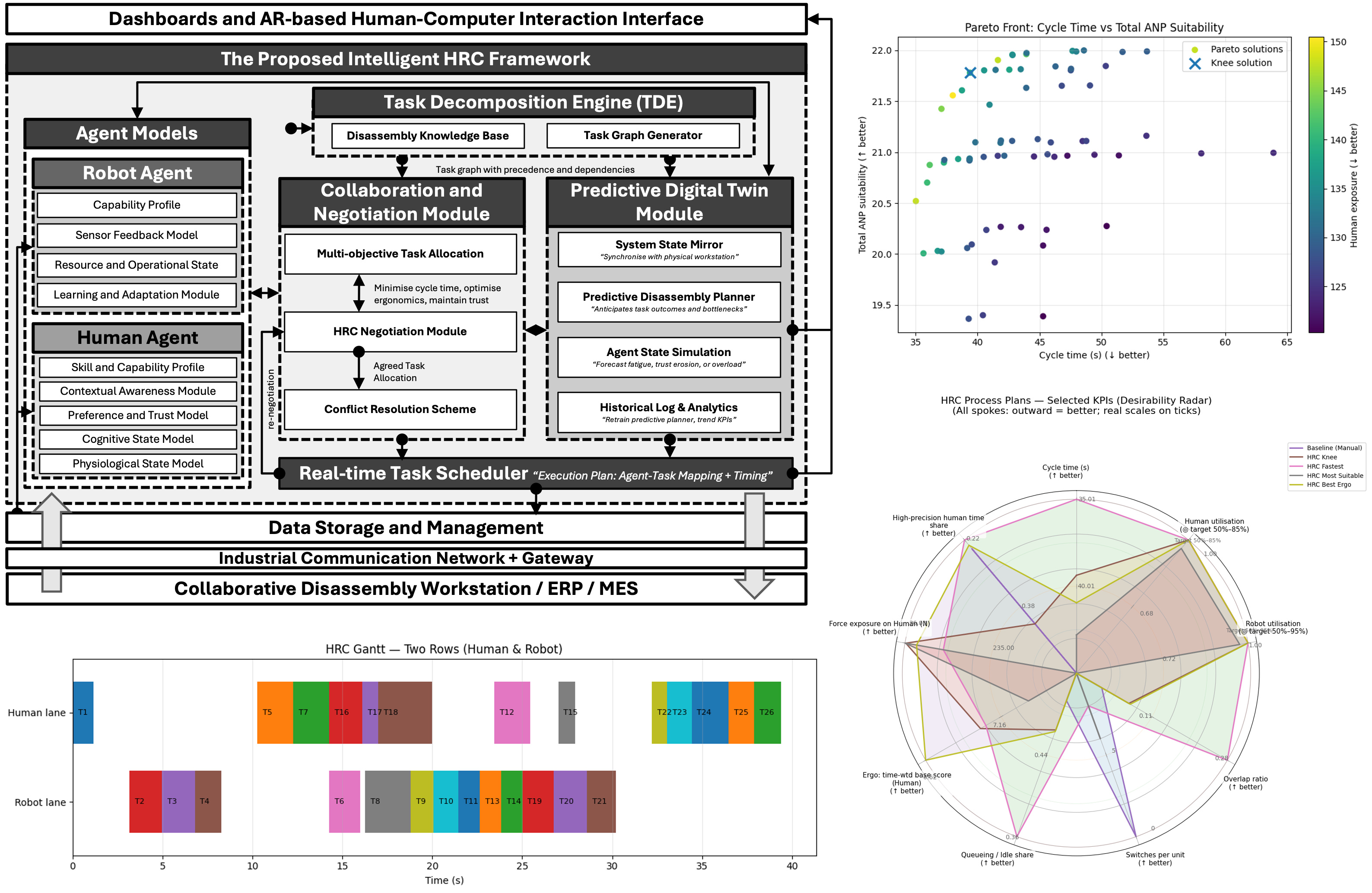
Human-state aware HRC for EoL disassembly, integrating operator state estimation, negotiated task allocation, and predictive digital twin validation.

Overview

This project develops a human-state aware Human-Robot Collaboration (HRC) framework tailored for end-of-life (EoL) disassembly of high-value products, where uncertainty, variability, and safety constraints make static task allocation brittle. The central contribution is an integrated architecture in which human and robot agent models are continuously updated from operational data, including operator physiological and cognitive state proxies (for example fatigue, stress, workload), enabling collaboration policies that respond to human condition and task context rather than assuming a fixed-capacity operator.

A key design choice is negotiated, runtime task allocation, not purely centralised optimisation. The human agent can express preferences and constraints in-the-loop, and the system converges to an executable plan through negotiation and conflict resolution. A predictive digital twin provides a validation layer, simulating task-level and agent-level dynamics to anticipate KPI impacts, task duration drift, and fatigue accumulation before committing to allocations.
Motivation
Disassembly remains labour-intensive because it is nonlinear, context-dependent, and highly variable. Robots can deliver precision and repeatability, but effective collaboration fails when assistance is insensitive to operator condition and rapidly changing shop-floor realities. Conventional HRC approaches in disassembly often rely on static allocations and do not integrate real-time ergonomics, workload, and trust calibration into the collaboration loop. This project targets adaptive and human-centric HRC where allocation and assistance policies react to operator state to reduce risk, prevent overload, and improve long-term wellbeing while maintaining throughput.
System Architecture

Adaptive Agent Modelling (Human and Robot)

  • Capability profiles, tool availability, and skill descriptors
  • Behavioural descriptors, e.g., preferences, workload thresholds, collaboration acceptance
  • Real-time human-state proxies, e.g., fatigue trends, stress indicators, workload and engagement cues

Task Decomposition Engine (Disassembly-Aware)

  • Converts disassembly objectives into executable task graphs
  • Encodes precedence and dependency logic essential for safe sequencing
  • Supports product structure signals (BoM/CAD where available) plus contextual constraints

Negotiation-Based Collaboration and Allocation

  • Multi-objective allocation across efficiency, feasibility, and ergonomics
  • Negotiation layer enabling runtime preference updates and constraints
  • Conflict resolution to ensure convergence to an agreed, executable plan

Predictive Digital Twin Validation Layer

  • Simulates system-level and agent-level state evolution over candidate plans
  • Forecasts KPIs, e.g., cycle time, workload accumulation, recovery likelihood, stability under uncertainty
  • Feeds predictions back into allocation and negotiation to improve robustness

Interface and Human-in-the-Loop Control

  • Visualises operator load, task status, and key safety indicators
  • Supports escalation and override pathways for practical deployment
Key Components
  • Human State Model
    A digital representation of operator condition that updates continuously and is used to prevent unsafe allocations and reduce ergonomic strain.

  • Disassembly Task Graph Builder
    Generates precedence-constrained task graphs so allocation decisions are executable, context-correct, and aligned with disassembly constraints.

  • Negotiation-Enhanced Task Allocation
    Allows the human agent to accept, reject, or modify allocations based on fairness, effort, ergonomics, and situational feasibility, improving autonomy and collaboration quality.

  • Predictive Digital Twin Forecaster
    Anticipates timing drift and workload accumulation, enabling proactive planning rather than reactive recovery.

  • Risk-Aware Execution Hooks
    Safety-aware triggers for slow-down, pause, re-plan, or request confirmation when uncertainty or risk increases.

Evaluation

The framework is designed for validation in an HRC testbed with repeatable EoL disassembly scenarios and controlled variability.

Evaluation focus includes:

  • Robustness of allocation under changing human state and contextual shifts
  • Ergonomic outcomes (proxy measures) and reduced overload or fatigue accumulation
  • Task performance KPIs (cycle time, recovery frequency, stability under uncertainty)
  • Collaboration quality, including allocation acceptance and perceived usability
  • Traceability of decisions, e.g., why an allocation changed and what state signals triggered it
Expected Outcomes
  • Safer collaboration under variability
    Adaptive policies reduce risk when operator condition deteriorates or the context becomes uncertain.

  • Better workload balancing
    Allocation decisions explicitly consider operator state, not just nominal task times or static capability assumptions.

  • Disassembly-ready HRC planning
    Task graphs and constraints reflect real disassembly dependencies, enabling executable and safer collaboration plans.

  • Deployable governance posture
    Negotiation traces and digital twin forecasts support post hoc analysis, justification, and continuous improvement.

Bugra Alkan

Bugra Alkan

Senior Lecturer in AI and Robotics

My research interests include human–robot collaboration, industrial AI and cyber-physical production systems.